á691ñCOTTON
Preparatory to the determination of absorbency and of fiber length,remove the Cotton from its wrappings,and condition it for not less than 4hours in a standard atmosphere of 65±2%relative humidity at 21±1.1 (70±2F).
(70±2F).Absorbency Test
Procedure—
Prepare a test basket,weighing not more than 3g,from copper wire approximately 0.4mm in diameter (No.26B.&S.)in the form of a cylinder approximately 5cm in diameter and 8cm deep,with spaces of about 2cm between the wires.Take portions of purified cotton weighing 1±0.05g from five different parts of the package by pulling,not cutting,the specimens,place the combined portions in the basket,and weigh.Hold the basket on its side approximately 12mm above the surface of water at 25±1,and drop it into the water.Determine,preferably by use of a stop watch,the time in seconds required for complete submersion.
,and drop it into the water.Determine,preferably by use of a stop watch,the time in seconds required for complete submersion.
Remove the basket from the water,allow it to drain for 10seconds in the same horizontal position,then place it immediately in a tared,covered vessel,and weigh,deducting the weight of the test basket and of the purified cotton to find the weight of water absorbed.
Fiber Length
For the determination of the length and of the length distribution of cotton fibers in purified cotton use the following method:
Carry out all operations associated with the determination of fiber length of purified cotton in an atmosphere maintained at 65±2%relative humidity at 21±1.1(70±2F).
(70±2F).These directions describe the mode of procedure that is well adapted to the sorter*most extensively used in the United States at the present time.
Apparatus—
The sorter (see illustration)
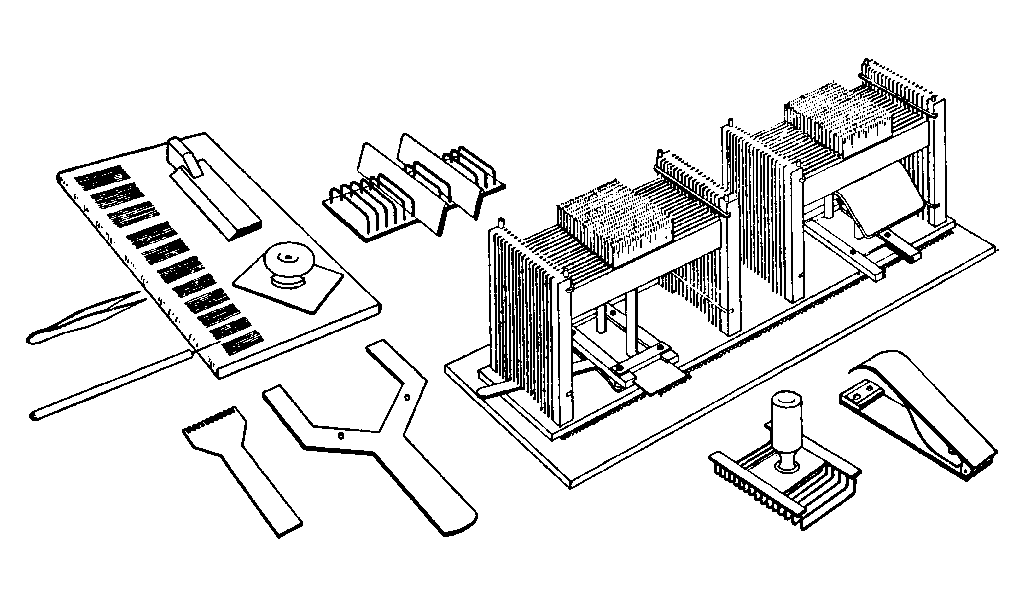 consists of two banks of combs rigidly mounted side by side on a common base.Each bank of combs consists of at least 12individual combs spaced 3.2mm apart,one behind the other,and mounted in grooves so that as they are approached during the fractionating process and no longer needed,they may be dropped below the working plane.Each individual comb has a single row of accurately aligned and sharply pointed teeth,12mm long,consisting of needles 0.38mm in diameter.The teeth are spaced 62to 25mm over an extent of approximately 50mm.
;)
Duplex Cotton Fiber Sorter
Accessory equipment consists of fiber-sorter forceps,fiber-depressing grid,fiber-depressing smooth plate,and velvet-covered plates.The sorter forceps consist of two brass pieces approximately 75mm long,hinged on one end and slightly curved to present a beaked aspect at the gripping end for gripping the protruding fibers close to the surfaces of the combs.Usually,one of the gripping edges has a leather or other fibrous padding.The gripping edge is approximately 19mm wide.
The fiber-depressing grid consists of a series of brass rods spaced 3.2mm apart so that they may be placed between the combs to press the fibers down between the teeth.The fiber-depressing smooth plate consists of a polished brass plate approximately 25×50mm,with a knob or handle on the upper surface whereby the plate may be smoothed over the fibers as they are laid on the velvet surface of the array plates.The velvet-covered plates,upon which the fibers may be arrayed,are aluminum sheets approximately 100mm ×225mm ×2.4mm thick,covered on both sides with high-grade velvet,preferably black.
Selection of Cotton—
After unrolling the cotton,prepare a representative laboratory test specimen by taking from a package containing from 8to 16ounces,32pinches (about 75mg each)well distributed throughout the bulk of the lap,16representative pinches being taken from each longitudinal half of the lap.Avoid the cut ends of the lap,and take particular care to secure portions throughout the thickness of the lap.To avoid biased selection of long or short fibers,remove all fibers of the group pinched and do not allow them to slip from between the fingers.
From packages of not more than 4ounces in weight,take 8pinches,and from packages weighing more than 4ounces and not more than 8ounces,take 16pinches,all well distributed.
Mix the pinches in pairs promiscuously,and combine each pair by gently drawing and lapping them in the fingers.Then divide each combined pair by splitting longitudinally into two approximately equal parts and utilize one part in the further mixing.(The other part may be discarded or reserved for any further tests or checks.)
Repeat the process described in the preceding paragraph with the successive halves of the bifurcated series until only 1pinch,the final composite test portion,results.Gently parallel and straighten the fibers of the final composite test portion by drawing and lapping them in the fingers.Take care to retain all of the fibers,including as far as possible those of the neps (specks of entangled fibers)and naps (matted masses of fibers),discarding only motes (immature seed fragments with fibers)and nonfiber foreign material such as stem,leaf,and fragments of seedcoats.
From the final composite portion described in the preceding paragraph,separate longitudinally a test portion of 75±2mg,accurately weighed.Retain the residue for any check test necessary.
Procedure—
With the fiber-depressing grid carefully insert the weighed test portion into one bank of combs of the cotton sorter,so that it extends across the combs at approximately right angles.
With the sorter forceps,grip by the free ends a small portion of the fibers extending through the teeth of the comb nearest to the operator;gently and smoothly draw them forward out of the combs,and transfer them to the tips of the teeth in the second bank of combs,laying them parallel to themselves,straight,and approximately at right angles to the faces of the combs,releasing the gripped ends as near to the face of the front comb as possible.With the depressor grid carefully press the transferred fibers down into the teeth of the combs.Continue the operation until all of the fibers are transferred to the second bank of combs.During this transfer of the fibers,drop the combs of the first bank in succession when and as all of the protruding fibers have been removed.
Turn the machine through 180,and transfer the cotton fibers back to the first bankof combs in the manner described in the preceding paragraph.
,and transfer the cotton fibers back to the first bankof combs in the manner described in the preceding paragraph.Take great care in evening up the ends of the fibers during both of the above transfers,arranging them as closely as possible to the front surface of the proximal comb.Such evening out of the ends of the protruding fibers may involve drawing out straggling fibers from both the front and rear aspects of the banks of combs,and re-depositing them into and over the main bundle in the combs.
Turn the machine again through 180.Drop successive combs if necessary to expose the ends of the longest fibers.It may be necessary to re-deposit some straggling fibers.With the forceps withdraw the few most protuberant fibers.In this way continue to withdraw successively the remaining protuberant fibers back to the front face of the proximal comb.Drop this comb and repeat the series of operations in the same manner until all of the fibers have been drawn out.In order not to disturb seriously the portion being tested,and thereby vitiate the length fractionation into length groups,make several pulls (as many as 8to 10)between each pair of combs.
.Drop successive combs if necessary to expose the ends of the longest fibers.It may be necessary to re-deposit some straggling fibers.With the forceps withdraw the few most protuberant fibers.In this way continue to withdraw successively the remaining protuberant fibers back to the front face of the proximal comb.Drop this comb and repeat the series of operations in the same manner until all of the fibers have been drawn out.In order not to disturb seriously the portion being tested,and thereby vitiate the length fractionation into length groups,make several pulls (as many as 8to 10)between each pair of combs.Lay the pulls on the velvet-covered plates alongside each other,as straight as possible,with the ends as clearly defined as possible,and with the distal ends arranged in a straight line,pressing them down gently and smoothly with the fiber-depressing smooth plate before releasing the pull from the forceps.Employ not fewer than 50and not more than 100pulls to fractionate the test portion.
Group together all of the fibers measuring 12.5mm (about 1/2inch)or more in length,and weigh the group to the nearest 0.3mg.In the same manner,group together all fibers 6.25mm (about 1/4inch)or less in length,and weigh in the same manner.Finally,group the remaining fibers of intermediate lengths together and weigh.The sum of the three weights does not differ from the initial weight of the test portion by more than 3mg.Divide the weight of each of the first two groups by the weight of the test portion to obtain the percentage by weight of fiber in the two ranges of length.
*
NOTE—The method here described is especially adapted to the Suter-Webb Duplex Cotton Fiber sorting apparatus,but with more or less obvious alteration in procedure,may be carried out with two Baer sorters in tandem arrangement,or with a Johannsen or other similar apparatus.