IDENTIFICATION AND ASSAY OF RADIONUCLIDES
Instrumentation
IONIZATION CHAMBERS
An ionization chamber is an instrument in which an electric field is applied across a volume of gas for the purpose of collecting ions produced by a radiation field.The positive ions and negative electrons drift along the lines of force of the electric field,and are collected on electrodes,producing an ionization current.In a properly designed well-type ionization chamber,the ionization current should not be too dependent on the position of the radioactive specimen,and the value of the current per unit activity,known as the calibration factor,is characteristic of each gamma-ray-emitting radionuclide.
The ionization current produced in an ionization chamber is related to the mean energy of the emitted radiation and is proportional to the intensity of the radiation.If standard sources of known disintegration rates are used for efficiency calibration,the ionization chamber may then be used for activity determinations between several microcuries and several hundred millicuries or more.The upper limit of activity that may be measured in an ionization chamber usually is not sharply defined and may be limited by saturation considerations,range of the amplifier,and design of the chamber itself.The data supplied with or obtained from a particular instrument should be reviewed to ascertain the useful ranges of energies and intensities of the device.
Reproducibility within approximately 5%or less can be readily obtained in about 10seconds,with a deep re-entrant well-type chamber.The most commonly used form of ionization chamber for measurement of the activities of radiopharmaceuticals is known as a dose calibrator.
Although the calibration factor for a radionuclide may be interpolated from an ionization chamber energy-response curve,there are a number of sources of error possible in such a procedure.It is therefore recommended that all ionization chamber calibrations be performed with the use of authentic reference sources of the individual radionuclides,as described hereinafter.
The calibration of a dose calibrator should be maintained by relating the measured response of a standard to that of a long-lived performance standard,such as radium 226in equilibrium with its daughters.The instrument must be checked daily with the 226Ra or other source to ascertain the stability over a long period of time.This check should include performance standard readings at all radionuclide settings employed.To obtain the activity (Ax)of the radionuclide being measured,use the relationship:
;)
in which Rnis the new reading for the radium or other source,Rcis the reading for the same source obtained during the initial calibration procedure,and Ris the observed reading for the radionuclide specimen.Obviously,any necessary corrections for radioactive decay of the reference source must first be applied.Use of this procedure should minimize any effects due to drift in the response of the instrument.The recommended activity of the 226Ra or other monitor used in the procedure described above is 75to 150µCi.It is recommended also that the reproducibility and/or stability of multirange instruments be checked for all ranges with the use of appropriate standards.
The size and shape of a radioactive source may affect the response of a dose calibrator,and it is often necessary to apply a small correction when measuring a bulky specimen.
SCINTILLATIONand SEMICONDUCTOR DETECTORS
When all or part of the energy of beta or gamma radiation is dissipated within scintillators,photons of intensity proportional to the amount of dissipated energy are produced.These pulses are detected by an electron multiplier phototube and converted to electrical pulses,which are subsequently analyzed with a pulse-height analyzer to yield a pulse-height spectrum related to the energy spectrum of the radiation emitted by the source.In general,a beta-particle scintillation pulse-height spectrum approximates the true beta-energy spectrum,provided that the beta-particle source is prepared in such a manner that self-absorption is minimized.Beta-ray spectra may be obtained by using calcium fluoride or anthracene as the scintillator,whereas gamma-ray spectra are usually obtained with a thallium-activated sodium iodide crystal or a large-volume lithium-drifted germanium semiconductor detector.The spectra of charged particles also may be obtained using silicon semiconductor detectors and/or gas proportional counters.Semiconductor detectors are in essence solid-state ionization chambers,but the energy required to create an electron-hole pair or to promote an electron from the valence band to the conduction band in the semiconductor is about one-tenth the energy required for creation of an ion-pair in a gas-filled ionization chamber or proportional counter and is far less than the energy needed to produce a photon in a NaI(Tl)scintillation crystal.In gamma-ray spectrometry,a Ge(Li)detector can yield an energy resolution of 0.33%for 1.33MeVgamma-rays from 60Co,while a 3-×3-inch NaI(Tl)crystal can give a value of 5.9%for the same gamma-ray energy.The energy resolution is a measure of the ability to distinguish the presence of two gamma rays closely spaced in energy and is defined by convention as the full width of the photopeak at its half maximum (FWHM),expressed in percentage of the photopeak energy.
Gamma-ray spectra exhibit one or more sharp,characteristic photopeaks,or full-energy peaks,as a result of total absorption in the detector of the full energy of gamma radiations from the source;these photopeaks are useful for identification purposes.Other secondary peaks are observed as a consequence of backscatter,annihilation radiation,coincidence summing,fluorescent X-rays,etc.,accompanied by a broad band known as the Compton continuum arising from scattering of the photons in the detector and from surrounding materials.Since the photopeak response varies with gamma-ray energy,calibration of a gamma-ray spectrometer should be achieved with radionuclide standards having well-known gamma-ray energies and emission rates.The shape of the gamma-ray spectrum is dependent upon the shape and size of the detector and the types of shielding materials used.
When confirming the identity of a radionuclide by gamma-ray spectrometry,it is necessary to make a comparison of the specimen spectrum with that of a specimen of known purity of the same radionuclide obtained under identical instrument parameters and specimen geometry.Where the radionuclides emit coincident X-or gamma-radiations,the character of the pulse-height distribution often changes quite dramatically because of the summing effect of these coincident radiations in the detector as the efficiency of detection is increased (e.g.,by bringing the source closer to the detector).Such an effect is particularly evident in the case of iodine 125.Among the more useful applications of gamma-ray spectrometry are those for the identification of radionuclides and the determination of radionuclidic impurities.
Where confirmation of the identity of a given radionuclide by means of a direct comparison with the spectrum of a specimen of the same radionuclide of known purity is not possible,the identity of the radionuclide in question must then be established by the following method.Two or more of the following nuclear decay scheme parameters of the radionuclide specimen to be identified shall be measured,and agreement shall be within ±10%:(1)half-life,(2)energy of each gamma-or X-ray emitted,(3)the abundance of each emission,and (4)Emaxfor those radionuclides that decay with beta-particle emissions.Such measurements are to be performed as directed in the Identificationand Assaysections of this chapter.Agreement of two or more of the measured parameters with the corresponding published nuclear decay scheme data constitutes confirmation of the identity of the radionuclide.
LIQUID-SCINTILLATION COUNTERS
Alpha-and beta-emitting radionuclides may be assayed with the use of a liquid-scintillation detector system.In the liquid scintillator,the radiation energy is ultimately converted into light quanta that are usually detected by two multiplier phototubes so arranged as to count only coincidence radiation.The liquid scintillator is a solution consisting of a solvent,primary and secondary solutes,and additives.The charged particle dissipates its energy in the solvent,and a fraction of this energy is converted into fluorescence in the primary solute.The function of the secondary solute is to shift the fluorescence radiation to longer wavelengths that are more efficiently detected by the multiplier phototubes.Frequently used solvents are toluene and p-xylene;primary solutes are 2,5-diphenyloxazole (PPO)and 2-(4¢-tert-butylphenyl)-5-(4-biphenylyl)-1,3,4-oxadiazole (butyl-PBD);and secondary solutes are 2,2¢-p-phenylenebis[4-methyl-5-phenyloxazole](dimethyl-POPOP)and p-bis(o-methylstrylyl)benzene (bis-MSB).As a means of attaining compatibility and miscibility with aqueous specimens to be assayed,many additives,such as surfactants and solubilizing agents,are also incorporated into the scintillator.For an accurate determination of radioactivity of the specimen,care must be exercised to prepare a specimen that is truly homogeneous.The presence of impurities or color in solution causes a decrease in photon output of the scintillator;such a decrease is known as quenching.Accurate radioactivity measurement requires correcting for count-rate loss due to quenching.
The disintegration rate of a beta-particle source may be determined by a procedure in which the integral count rate of the specimen is measured as a function of the pulse-height discriminator bias,and the emission rate is then obtained by extrapolation to zero bias.Energetic alpha-particle emitters may be similarly measured by this method.
Identification
Aradionuclide can be identified by its mode of decay,its half-life,and the energies of its nuclear emissions.
The radioactive half-life is readily determined by successive counting of a given source of the radionuclide over a period of time that is long compared to its half-life.The response of the counting assembly when employed for the decay measurement of long-lived radionuclides should be monitored with an even longer-lived reference source to assess and compensate for errors arising from electronic drift.In the case of short-lived radionuclides,when the counting period constitutes a significant fraction of the half-life of the radionuclide,the recorded count rate must be corrected to the time when the count is initiated,as follows:
;)
in which Rtis the count rate at the beginning of a counting period,ris the count rate observed over the entire counting period,tis the duration of the counting period,lis the decay constant of the radionuclide,and eis the base of the natural logarithm.When tis small compared to the half-life of the radionuclide under study so that lt<0.05,then (1–elt)approaches lt,and no such correction is necessary.
The energy of nuclear emissions is often determined by the maximum range of penetration of the radiation in matter (in the case of alpha-and beta-particles)and by the full-energy peak or photopeak in the gamma-ray spectrum (in the case of X-and gamma-rays).Since beta-particles are emitted with a continuous energy spectrum,the maximum beta-energy,Emax,is a unique index for each beta-emitting radionuclide.In addition to the maximum range and energy spectrum of the beta-particles,the absorption coefficient,when obtained under reproducible counting conditions,can serve as a reliable index for identification of a beta-emitter.Fortuitously,beta-particles are absorbed in matter in an approximately exponential manner,and a plot of the logarithm of the beta-particle count rate as a function of the absorber thickness is known as the absorption curve.The initial portion of the absorption curve shows linearity from which the absorption coefficient can be obtained.The maximum range is determined by the use of absorbers of varying thickness,and the energy spectrum is measured by beta-ray scintillation spectrometry.
The absorption of gamma-rays in matter is strictly exponential,but the half-value layers of attenuation have not been very useful for the purpose of radionuclide characterization.Gamma-rays from each isomeric transition are mono-energetic;their energy can be directly measured by gamma-ray spectrometry.Because of their high energy resolution,solid-state detectors [Ge(Li)]are vastly superior to scintillation detectors [NaI(Tl)]in gamma-ray spectrometry.
The activities of radiopharmaceutical solutions are frequently in the range of millicuries per mL.Such solutions usually must be extensively diluted before they can be accurately assayed.The diluent should be compatible with the radiopharmaceutical with respect to factors such as pHand redox potentials,so that no hydrolysis or change in oxidation state occurs upon dilution,which could lead to adsorption and separation of the radionuclide from solution.
BETA-EMITTING RADIONUCLIDES
Mass Absorption Coefficient Procedure—
Deposit and dry an aliquot of the radioactive phosphorus 32solution on a thin plastic film to minimize backscattering,and place it under a suitable counter.Determine the counting rates successively,using not less than six different “thicknesses”of aluminum each between 20and 50mg/cm2and a single absorber thicker than 800mg/cm2,which is used to measure the background.(The absorbers are inserted between the test specimen and the counter but are placed nearer the counter window to minimize scattering.)Net beta-particle count rates are obtained after subtraction of the count rate found with the absorber having a thickness of 800mg/cm2or greater.Plot the logarithm of the net beta-particle count rate as a function of the total absorber “thickness.”The total absorber “thickness”is the “thickness”of the aluminum absorbers plus the “thickness”of the counter window (as stated by the manufacturer)plus the air-equivalent “thickness”(the distance in centimeters of the specimen from the counter window multiplied by 1.205mg/cm3at 20 and 76cm of mercury),all expressed in mg/cm2.An approximately straight line results.

and 76cm of mercury),all expressed in mg/cm2.An approximately straight line results.
Choose two total absorber “thicknesses”that differ by 20mg/cm2or more and that fall on the linear plot,and calculate the mass absorption coefficient,µ,by the equation:
;)
in which t1and t2represent the total absorber “thicknesses,”in mg/cm2,t2being the thicker absorber,and Nt1and Nt2being the net beta-particle rates with the t1and t2absorbers,respectively.
For characterization of the radionuclide,the mass absorption coefficient should be within ±5%of the value found for a pure specimen of the same radionuclide when determined under identical counting conditions and geometry.
Other Methods of Identification—
Other methods for determining the identity of a beta emitter also rely upon the determination of Emax.This may be accomplished in several ways.For example,(1)utilization of the range energy relationships of beta particles in an absorber,or (2)determination of Emaxfrom a beta-particle spectrum obtained on an energy-calibrated beta-spectrometer using a thin source of the radionuclide (see Scintillation and Semiconductor Detectorsin this chapter).
GAMMA-EMITTING RADIONUCLIDES
The gamma-ray spectrum of a radionuclide is a valuable tool for the qualitative identification of gamma-ray emitting radionuclides.The full-energy peak,or the photopeak,is identified with the gamma-ray transition energy that is given in the decay scheme of the radionuclide.
In determining radionuclidic identity and purity,the gamma-ray spectrum of a radioactive substance is obtained with either a NaI(Tl)crystal or a semiconductor Ge(Li)detector.The latter has an energy resolution more than an order of magnitude better than the former and is highly preferred for analytical purposes.The spectrum obtained shall be identical in shape to that of a specimen of the pure radionuclide,measured with the same detection system and in the same geometry.The gamma-ray spectrum of the radiopharmaceutical shall contain only photopeaks identifiable with the gamma-ray transition energies found in the decay scheme of the same radionuclide.For low geometrical efficiencies,the areas under the photopeaks,after correction for the measured detector efficiency,shall be proportional to the abundances or emission rates of the respective gamma-rays in the radionuclide.
RADIONUCLIDIC IMPURITIES
Because they are extremely toxic,alpha-emitting nuclides must be strictly limited in radiopharmaceutical preparations.Procedures for identifying beta-and gamma-active radionuclides as given in the foregoing text are applicable to the detection of gamma and usually beta contaminants.
The gross alpha-particle activity in radiopharmaceutical preparations can be measured by the use of a windowless proportional counter or a scintillation detector employing a silver-activated zinc-sulfide phosphor or by the techniques of liquid-scintillation counting.
The heavy ionization caused by alpha particles allows the measurement of alpha-emitting radionuclides in the presence of large quantities of beta-and gamma-active nuclides by the use of appropriate techniques for discriminating the amplitudes of signal pulses.In proportional counting,the operating voltage region for counting alpha particles,referred to as the “alpha plateau,”is considerably lower than the “beta plateau”for counting beta and gamma radiations.Typical “alpha plateau”and “beta plateau”voltage settings with P-10counting gas are 900to 1300and 1600to 2000volts,respectively.
When silver-activated zinc-sulfide phosphor is employed for alpha-particle detection,the alpha particles can be distinguished from other interfering radiation by pulse-height discrimination.Care must be exercised to minimize self-absorption at the source whenever specimens are prepared for alpha-particle counting.
Assay
BETA-EMITTING RADIONUCLIDES
Procedure—
The disintegration rate (A)of a beta-particle-emitting specimen is obtained by counting a quantitatively deposited aliquot in a fixed geometry according to the formula:
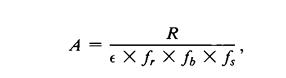 in which eis the counting efficiency of the counter;fris the correction factor for counter dead time;fbis the correction factor for backscatter;and fsis the correction factor for self-absorption.The count rate for zero absorber is obtained by extrapolation of the initial linear portion of the absorption curve to zero absorber “thickness,”taking into consideration the mg/cm2“thickness”of specimen coverings,counter window,and the intervening air space between specimen and the counter window.The counter efficiency,e,is determined by use of a long-lived secondary standard with similar spectral characteristics.RaD+Ehas frequently been used for efficiency calibration of counters for phosphorus 32.By the use of identical measurement conditions for the specimen and the standard (and extrapolation to zero absorber),the ratio of the values of fr,fb,and fsfor the standard and the specimen approaches unity.
;)
The previous relationship is valid also when the counter has been calibrated with a standard of the radionuclide to be assayed.In this case,however,the extrapolations to zero absorber “thickness”for the specimen and standard are not required,as the two absorption corrections cancel for a given geometry.
Another useful and frequently employed method for the determination of the disintegration rate of beta-emitting radionuclides is liquid-scintillation counting,which also utilizes an extrapolation of the specimen count rate to zero pulse-height discriminator bias.
GAMMA-EMITTING RADIONUCLIDES
For the assay of gamma-emitting radionuclides,three methods are provided.The selection of the preferred method is dictated by the availability of a calibration standard of the radionuclide to be assayed and the radionuclidic purity of the article itself.
Direct comparison with a calibration standard is required if a calibration standard of the radionuclide to be assayed is available and if the upper limit of conceivable error in the activity determination arising from the presence of radionuclidic impurities has been determined to be less than 3%.If the required calibration standard is not routinely available,as would probably be the case for a short-lived radionuclide,but was available at some time prior to the performance of the assay for determination of efficiency of the counting system for the radionuclide to be assayed,use a calibrated counting system,provided the radionuclidic impurity content of the specimen meets the requirements stated for the direct comparison method.If the requirements for either of the first two methods cannot be met,use the method for determination of activity from a calibration curve.
With the exception of the first method,the counting systems used are monitored for stability.This requirement is met by daily checks with a long-lived performance check source and weekly checks with at least three sources covering a broad range of gamma-ray emission energies (e.g.,57Co,137Cs,and 60Co).If a discrepancy for any of the aforementioned measurements is found,either completely recalibrate or repair and recalibrate the system prior to further use.
Assay by Direct Comparison with a Calibration Standard—
An energy selective measurement system (e.g.,pulse-height analyzer)is not required for this procedure.Use either an ionization chamber or an integral counting system with a NaI(Tl)detector.Aconsistently reproducible geometrical factor from specimen to specimen is essential for accurate results.With proper precautions,the accuracy of this method approaches the accuracy with which the disintegration rate of the calibration standard is known.
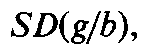
Determine the counting rate of the detector system for a calibration standard of the radionuclide to be assayed (e.g.,active enough to give good measurement statistics in a reasonable time,but not so active as to cause serious dead-time problems),selecting such a standard as to provide optimum accuracy with the particular assembly used.Place an accurately measured aliquot of the unknown assay specimen (diluted,if necessary)in a container identical to that used for the standard,and measure this specimen at approximately the same time and under the same geometrical conditions as for the standard.If the elapsed time between the measurements of the calibration standard and the specimen exceeds 12hours,check the stability of the measurement system within 8hours of the specimen measurement time with a long-lived performance check source.Record the system response with respect to the same check source at the time of calibration,and if subsequent checks exceed the original recorded response by more than ±3%,recalibration is required.Correct both activity determinations for background,and calculate the activity,in µCi per mL,by the formula:
;)
in which Sis the µCi strength of the standard,Dis the dilution factor,and gand bare the measured values of counting rate for the specimen and the standard,respectively.
Assay with a Calibrated Integral Counting System—
The procedure and precautions given for the preceding direct-comparison method apply,except that the efficiency of the detector system is determined and recorded for each radionuclide to be assayed,rather than simply recording the counting rate of the standard.Thus,the efficiency for a given radionuclide,x,is determined by ex=bx/sx,in which bxis the counting rate,corrected for background and dead-time,for the calibration standard of the radionuclide,x,and sxis the corresponding activity of the certified calibration standard in nuclear transformations per second.For subsequent specimen assays,the activity is given by the formula:
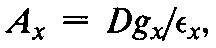 in which Dis the dilution factor,gxis the specimen counting rate (corrected for background and dead-time),and exis the corresponding efficiency for the radionuclide.
;)
Determination of Activity from a Calibration Curve—
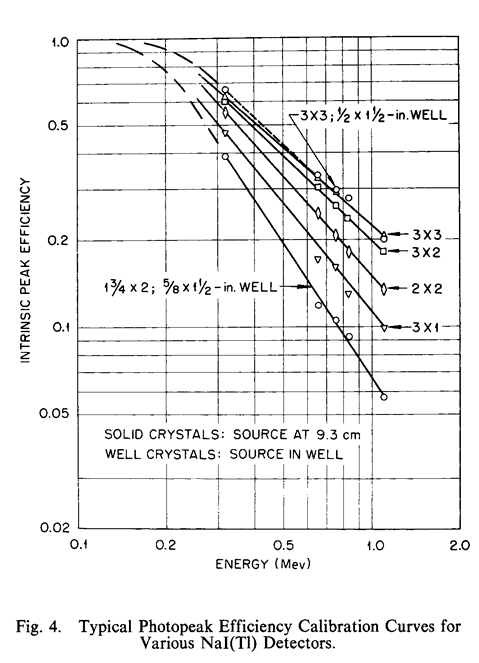
Versatility in absolute gamma-ray intensity measurements can be achieved by employing multi-channel pulse-height analysis.The photopeak efficiency of a detector system can be determined as a function of gamma-ray energy by means of a series of gamma-ray emission rate standard specimens,and the gamma-ray emission rate of any radionuclide for which no standard is available can be determined by interpolation from this efficiency curve.However,exercise care to ensure that the efficiency curve for the detector system is adequately defined over the entire region of interest by using a sufficient number of calibration points along the photopeak-energy axis.
Selection of a Counting Assembly—
Agamma-ray spectrometer is used for the identification of radionuclides that emit X-rays or gamma rays in their decay.Requirements for an assembly suitable for identification and assay of the radionuclides used in radiopharmaceuticals are that (a)the resolution of the detector based on the 662-keVphotopeak of 137Cs-137mBa must be 8.0%or better,(b)the detector must be equipped with a specimen holder designed to facilitate exact duplication of counting geometry,and (c)the pulse-height analyzer must have enough channels to delineate clearly the photopeak being observed.
Procedure—
Minimal requirements for the maintenance of instrument calibrations shall consist of weekly performance checks with a suitable reference source and a complete recalibration semi-annually.Should the weekly performance check deviate from the value determined at the time of calibration by more than 4.0%,a complete recalibration of the instrument is required at that time.
This method involves three basic steps,namely photopeak integration,determination of the photopeak efficiency curve,and calculation of the activity of the specimen.
PHOTOPEAK INTEGRATION—
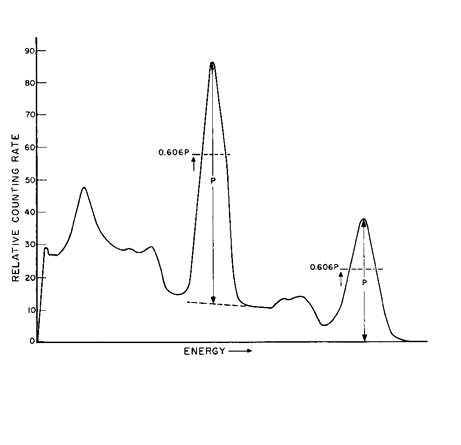
The method for the determination of the required photopeak area utilizes a Gaussian approximation for fitting the photopeak.Afixed fraction of the total number of photopeak counts can be obtained by taking the peak width,a,at some fraction of the maximum,where the shape has been experimentally found to be very close to Gaussian,and multiplying by the counting rate of the peak channel,P,after correction for any Compton and background contributions to the peak channel count rate.This background usually can be adequately determined by linear interpolation.This is illustrated in Figure 2.

;)
Fig.2Typical Gamma-ray Spectrum Showing the Selection of the Peak Channel Counting Rate,P,after the Correction for Compton and Background Contributions.
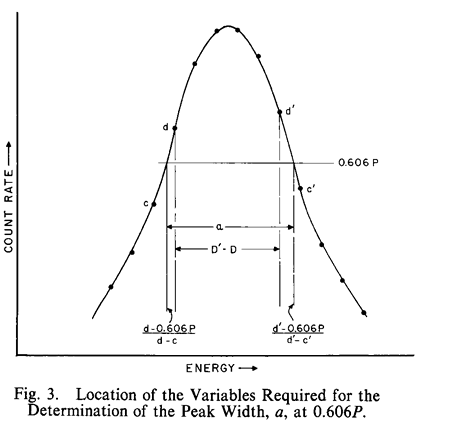
The photopeak-curve shape is closest to a straight line at 0.606P,and the contribution of the fractional channels to acan be accurately estimated by interpolation.Calculate aby the equation:
;)
in which cand dand also c¢and d¢are the single channel countingrates on either side of 0.606P,and Dand D¢are the channel numbers(locations)of dand d¢,respectively.The location of the required variables on the photopeak is illustrated in Figure 3.
;)
From the known values for the counting rate in the peak channel of the photopeak,P,and the width of the peak at 0.606P,a,a calibrated fraction of the photopeak area is then obtained from the product,(aP).
To summarize the procedures involved in obtaining a calibrated fraction of a photopeak area using this method,the necessary steps or calculations are presented below in a stepwise manner:
(1)Subtract any Compton and background contributions from the photopeak to be measured.
(2)Determine the counting rate of the peak channel (maximum channel counting rate after subtracting Compton and background),P.
(3)Multiply Pby 0.606,and locate the horizontal line corresponding to the peak width,a.
(4)Obtain the peak width,a,by inserting the values of variables (obtained as shown in the preceding figure)into the equation defining a.
(5)The desired calibrated fraction of the peak area is then equal to the product of atimes Por F=aP,where Fis a fractional area of the peak proportional to the emission rate of the source.
This method provides a quick and accurate means of determining the gamma-ray emission rate of sources while avoiding,to a large extent,subjective estimates of the detailed shape of the tails of the peaks.The error due to using the maximum channel counting rate,rather than the theoretical maximum or peak channel rate,is of the order of 1.0%if ais 6or greater.
PHOTOPEAK EFFICIENCY CALIBRATION—
Radionuclides such as those listed in the accompanying table together with some of their nuclear decay data are available as certified reference standards.*Asufficient number of radioactive standard reference sources should be selected in order to obtain the calibration curve over the desired range.Where possible,standard sources of those radionuclides that are to be assayed should be included.
| Principal Photon Emissions | Energy (ke V) |
Photons per 100 Disintegrations |
| 133Ba (T1/2=10.5years) | ||
| Ka1 | 30.97 | 63.4 |
| Ka2 | 30.62 | 34.2 |
| Kb | 35.0 | 22.8 |
| g1 | 53.15 | 2.14 |
| g2 | 79.62 | 2.55 |
| g3 | 80.99 | 33.0 |
| g6 | 276.39 | 6.9 |
| g7 | 302.83 | 17.8 |
| g8 | 356.0 | 60.0 |
| g9 | 383.85 | 8.7 |
| 137Cs-137mBa (T1/2=30.17years) | ||
| Ka1 | 32.19 | 3.82 |
| Ka2 | 31.82 | 2.07 |
| Kb | 36.4 | 1.39 |
| Weighted Mean(4) | (32.9) | (7.28) |
| g1 | 661.6 | 89.98 |
| 22Na (T1/2=2.60years) | ||
| hn | 511 | 179.80(5) |
| g1 | 1274.54 | 99.94 |
| 60Co(T1/2=5.27years) | ||
| g1 | 1173.2(6) | 100.0 |
| g2 | 1332.5(6) | 100.0 |
| 57Co(T1/2=270.9days) | ||
| SXK | 7.0 | 56.0 |
| g1 | 14.4 | 9.5 |
| g2 | 122.06 | 85.51 |
| g3 | 136.47 | 10.60 |
| Weighted Mean | (125.0) | (96.11) |
| (g2+g3)(4) | ||
| 54Mn (T1/2=312.7days) | ||
| SXK | 6.0 | 25.0 |
| g1 | 834.83 | 99.98 |
| 109Cd-109Ag(T1/2=464days) | ||
| Ka1 | 22.16 | 35.3 |
| Ka2 | 21.99 | 18.6 |
| Kb | 24.9 | 11.4 |
| Weighted Mean(4) | 63.5 | |
| g1 | 88.0 | 3.72 |
| 129I(T1/2=1.57×107years) | ||
| Ka1(3) | 29.78 | 37.0 |
| Ka2 | 29.46 | 20.0 |
| Kb | 13.2 | 37.0 |
| g1 | 39.58 | 7.52 |
| Weighted Mean(4) | (31.3) | (77.80) |
|
(1)
In measurements for gamma-(or X-)ray assay purposes,fluorescent radiation from lead shielding (specifically,lead K X-rays ~76ke V)may interfere with quantitative results.Allowance must be made for these effects,or the radiation suppressed;a satisfactory means of absorbing this radiation is covering the exposed lead with cadmium sheet 0.06to 0.08inch thick,and then covering the cadmium with copper 0.02to 0.04inch thick.
(2)
Only those photon emissions having an abundance ³1%are normally included.
(3)
The Knotation refers to X-ray emissions.
(4)
The weighted mean energies and total intensities are given for groups of photons that would not be resolved by a NaI(Tl)detector.
(5)
For this photon intensity to be usable,all emitted positrons must be annihilated in the source material.
(6)
Cascade.
|
||
Calculate the gamma-ray emission rate from the equation:
G=Asb,
in which Asis the activity,in disintegrations per second,of the standard used,and bis the number of gamma rays per disintegration at that energy.Accurately measure quantities of standard solutions of each radionuclide into identical containers,and determine the fractional photopeak area (F)for each of the standards.
Using the equation ep=F/G,calculate the photopeak efficiency,ep,and construct a log-log plot of ep versus the gamma-ray energy as shown in Figure 4.
;)
DETERMINATION OF SPECIMEN ACTIVITY—
In the same manner as in the preparation of the calibration curve,determine the fractional area (F)of the principal photopeak of the specimen under assay or an accurately measured aliquot adjusted to the same volume in an identical container as used for the standards.From the calibration curve,find the value of epfor this radionuclide.Using the equation G=F/ep,calculate the gamma-ray emission rate (G).Calculate the activity (A),in disintegrations per second,of the specimen using the equation A=(G/b)(D),in which bis the number of gamma rays per disintegration and Dis the dilution factor.To obtain the activity,in µCi or mCi,divide Aby 3.7×10⁴or 3.7×10⁷,respectively.The above relationship is equally valid for obtaining the activity of an undiluted specimen or capsule;in this case,the dilution factor,D,is unity.