Glucagon
;)
Glucagon (pig).
Glucagon [16941-32-5].
»Glucagon is a polypeptide hormone that has the property of increasing the concentration of glucose in the blood.It is obtained from porcine and bovine pancreas glands.
Packaging and storage—
Preserve in tight glass containers,under nitrogen,in a refrigerator.
Identification—
The retention time of the major peak in the chromatogram of the Test solutioncorresponds to that in the chromatogram of the Standard solution,as obtained in the test for Chromatographic purity.
Water,Method Iá921ñ:
not more than 10.0%.
Residue on ignition á281ñ:
not more than 2.5%.
Chromatographic purity—
Phosphate–cysteine buffer solution—
Dissolve 18.9g of monobasic sodium phosphate and 0.327g of L-cysteine in 970mLof water,adjust with phosphoric acid to a pHof 2.6,and dilute with water to 1000mL.
Sample solvent—
Transfer 20.0mLof acetonitrile to a 100-mLvolumetric flask,and dilute with 0.01Nhydrochloric acid to volume.
Mobile phase—
Mix 270mLof acetonitrile and 730mLof Phosphate–cysteine buffer solution,and degas.
Standard solution—
Dissolve an accurately weighed quantity of USP Glucagon RSin Sample solventto obtain a solution having a known concentration of about 0.5mg per mL.
System suitability solution—
Dissolve an accurately weighed quantity of USP Glucagon RSin Sample solventto obtain a solution containing about 0.5mg per mL.Heat the solution at 75 for at least 3hours to allow the formation of related substance GLU(24)Glucagon.
for at least 3hours to allow the formation of related substance GLU(24)Glucagon.
Test solution—
Transfer about 12.5mg of Glucagon,accurately weighed,to a 25-mLvolumetric flask,and dissolve in Sample solventto obtain a solution containing about 0.5mg per mL.
Chromatographic system(see Chromatography á621ñ)—
The liquid chromatograph is equipped with a 214-nm detector and a 4.6-mm ×25-cm column that contains 5-µm packing L7.The column temperature is maintained at 35,and the flow rate is about 1.0mLper minute.Chromatograph the System suitability solution,and record the peak responses as directed for Procedure:the resolution,R,between the main peak and the large peak with a relative retention time of 1.3is not less than 4.0;and the tailing factor for the glucagon peak is not greater than 1.7.
,and the flow rate is about 1.0mLper minute.Chromatograph the System suitability solution,and record the peak responses as directed for Procedure:the resolution,R,between the main peak and the large peak with a relative retention time of 1.3is not less than 4.0;and the tailing factor for the glucagon peak is not greater than 1.7.
Procedure—
Separately inject equal volumes (about 50µL)of the Standard solutionand the Test solutioninto the chromatograph,record the chromatograms,and measure the peak responses.Calculate the percentage of each impurity in the portion of Glucagon taken by the formula:
100(ri/rs),
in which riis the peak response for each individual impurity obtained from the Test solution;and rsis the sum of the responses of all the peaks:not more than 2.5%of any individual impurity is found;and not more than 10.0%of total impurities is found.
Nitrogen content,Method IIá461ñ:
between 16.0%and 18.5%,calculated on the anhydrous basis.
Zinc content á591ñ:
not more than 0.05%.
Assay—
[NOTE—All buffers have a final pHof 7.4,unless otherwise indicated.]
HEPATOCYTE PREPARATION—
Calcium-free perfusion buffer with dextrose—
Prepare a solution containing,in each L,7.92g of sodium chloride,0.35g of potassium chloride,1.80g of dextrose,0.19g of edetic acid,and 2.38g ofN-2-hydroxyethylpiperazine-N¢-2-ethanesulfonic acid.Oxygenate prior to circulation.
Collagenase buffer—
Prepare a solution containing,in each L,3.62g of sodium chloride,23.83g ofN-2-hydroxyethylpiperazine-N¢-2-ethanesulfonic acid,0.35g of potassium chloride,0.52g of calcium chloride,and 1.8g of dextrose.Adjust to a pHof 7.6,and oxygenate.Immediately before perfusion,dissolve a quantity of collagenase in this solution to obtain a concentration of 0.02%to 0.05%.
Wash buffer—
Prepare a solution containing,in each L,7.92g of sodium chloride,0.35g of potassium chloride,0.19g of edetic acid,2.38g ofN-2-hydroxyethylpiperazine-N¢-2-ethanesulfonic acid,0.22g of calcium chloride,and 0.12g of magnesium sulfate.
Incubation buffer—
Prepare a solution containing,in each L,6.19g of sodium chloride,0.35g of potassium chloride,0.22g of calcium chloride,0.12g of magnesium sulfate,0.16g of monobasic potassium phosphate,11.915g ofN-2-hydroxyethylpiperazine-N¢-2-ethanesulfonic acid,and 1%bovine serum albumin.Adjust to a pHof 7.5.
Test animals—
Male Sprague-Dawley rats are maintained on a standard rat chow diet and freely given water.On the morning of the test,select a healthy rat weighing approximately 300g,and administer 100Units of Heparin Sodium subcutaneously.
Procedure—
[NOTE—Conduct this procedure in the morning to ensure that the rat has optimal glycogen in its liver.]Anesthetize the rat with an appropriate anesthetic.Open the abdominal cavity,and isolate the portal vein.Insert an angiocatheter connected to a perfusion pump,and tie into the portal vein at the general location of the lienal branch.Start the perfusion (25mLper minute)in situ with Calcium-free perfusion buffer with dextrose,equilibrated with oxygen,at a temperature of 37.As the liver enlarges,cut the inferior vena cava to allow pressure equilibrium.[NOTE—About 300mLof the perfusate is needed to clear the liver of red blood cells at a flow rate of 30to 60mLper minute.]Then circulate Collagenase bufferat a flow rate of 30to 60mLper minute for about 10minutes.The exact concentration of collagenase (within the range of 0.02%to 0.05%)is determined empirically for each lot of enzyme.The concentration of collagenase is that necessary to consistently cause a breakdown of the liver about 10minutes after initial entry of the Collagenase bufferinto the liver.When the liver significantly increases in size,changes color and consistency,and starts to leak perfusate out of the lobes,change the system to the oxygenated prewarmed Wash buffer.About 100mLof Wash bufferis needed to wash the liver of collagenase at a flow rate of 25mLper minute.Surgically remove the liver from the animal and place in a prewarmed tray containing oxygenated Wash buffer(37).Gently comb the liver with a stainless steel,fine-toothed comb to free the hepatocytes.Wash the hepatocytes with Wash buffer,and filter through cheesecloth (or a 150-µm mesh polyethylene net)into a plastic beaker.Centrifuge the cell suspension for about 2minutes at about 25×gto form a loosely packed pellet.Discard the supernatant,and resuspend the pellet in Wash buffer.Repeat the washing procedure twice for a total of three washes.Resuspend the final pellet in 100to 200mLof Incubation buffer,depending on cell yield.[NOTE—If the Assayprocedure is interrupted,cool the cells by collecting them in a beaker placed in ice.The cells are washed with ice-cold Wash bufferand stored on ice until ready for use.At that point the cells are pelleted once more and resuspended in ice-cold Incubation buffer.]
.As the liver enlarges,cut the inferior vena cava to allow pressure equilibrium.[NOTE—About 300mLof the perfusate is needed to clear the liver of red blood cells at a flow rate of 30to 60mLper minute.]Then circulate Collagenase bufferat a flow rate of 30to 60mLper minute for about 10minutes.The exact concentration of collagenase (within the range of 0.02%to 0.05%)is determined empirically for each lot of enzyme.The concentration of collagenase is that necessary to consistently cause a breakdown of the liver about 10minutes after initial entry of the Collagenase bufferinto the liver.When the liver significantly increases in size,changes color and consistency,and starts to leak perfusate out of the lobes,change the system to the oxygenated prewarmed Wash buffer.About 100mLof Wash bufferis needed to wash the liver of collagenase at a flow rate of 25mLper minute.Surgically remove the liver from the animal and place in a prewarmed tray containing oxygenated Wash buffer(37).Gently comb the liver with a stainless steel,fine-toothed comb to free the hepatocytes.Wash the hepatocytes with Wash buffer,and filter through cheesecloth (or a 150-µm mesh polyethylene net)into a plastic beaker.Centrifuge the cell suspension for about 2minutes at about 25×gto form a loosely packed pellet.Discard the supernatant,and resuspend the pellet in Wash buffer.Repeat the washing procedure twice for a total of three washes.Resuspend the final pellet in 100to 200mLof Incubation buffer,depending on cell yield.[NOTE—If the Assayprocedure is interrupted,cool the cells by collecting them in a beaker placed in ice.The cells are washed with ice-cold Wash bufferand stored on ice until ready for use.At that point the cells are pelleted once more and resuspended in ice-cold Incubation buffer.]
Suitability—
The concentrations of cells may vary because of the collagenase activity and the viability of the hepatocytes.To check cell viability and to determine viable cell concentration,dilute duplicate 100-µLaliquots of cell suspension with 400µLof Wash bufferand 500µLof isotonic 0.4%trypan blue.The aliquots are counted in a hemocytometer.The cells are suspended in Incubation bufferto obtain a viable cell concentration of not less than 3×10⁶per mL.Count several distinct fields.[NOTE—Viable cells are those cells that exclude the trypan blue.]
NEGATIVE CONTROL SOLUTION—
Prepare a solution containing 0.5%bis(trimethylsilyl)acetamide (BSA)in sterile water.
INCUBATION FLASKS—
Use 25-mLconical flasks,the bottoms of which have been heated and pushed inward to form a conically raised center.
STANDARD PREPARATIONS—
In duplicate,dissolve a suitable quantity of USP Glucagon RS,accurately measured,in 0.01Nhydrochloric acid or other suitable diluent to obtain a solution containing 1.0USP Glucagon Unit per mL.All dilutions thereafter are made using 0.5%BSA(w/v)in water.Accurately dilute measured volumes of each solution with Negative control solutionto obtain five concentrations—200,100,50,25,and 12.5micro-Units per mL—of each solution(Standard preparations).Pipet 0.2mLof each Standard preparationinto separate Incubation flasks.Pipet 0.2mLof Negative control solutioninto each of two flasks(Negative control solutions 1and 2).Then add the hepatocytes into each of the 12flasks.
ASSAY PREPARATIONS—
Using accurately weighed quantities of Glucagon,proceed as directed for Standard preparations.
D-GLUCOSE DETERMINATION—
Standard stock solution—
Transfer 2.0g of USP Dextrose RS,accurately weighed,to a 200-mLvolumetric flask;and dissolve in and dilute with saturated benzoic solution to volume.
Standard solutions—
Transfer suitable quantities of Standard stock solutionto three flasks,and dilute with saturated benzoic acid solution to obtain solutions having known concentrations of 0.5,1.0,and 1.5times the typical sample glucose concentration.
Potassium ferrocyanide solution—
Dissolve 1.25g of trihydrate potassium ferrocyanide in 125mLof Sterile Water for Injection.
System suitability—
Analyze the Potassium ferrocyanide solution,the Standard solutions,and five replicates of the middle Standard solution.Prepare a standard curve using the Standard solutionsas directed for Procedure:the relative standard deviation of the standard curve is not more than 2.0%;the response of the Potassium ferrocyanide solutionis not more than 30mg per L;and the relative standard deviation is not more than 2.0%for the replicate analyses of the middle Standard solution.
PROCEDURE—
Dispense 5mLof Hepatocyte preparationinto the special incubation flasks in sequence from high glucagon concentration to low glucagon concentration,alternating the Standard preparationswith the Assay preparations.The flasks are swirled in an orbiting water bath at 125rpm at 30for approximately 30to 60minutes.[NOTE—The exact incubation time must be determined to optimize the signal-to-noise ratio.]Following incubation,place 0.5-to 1.0-mLaliquots,in duplicate,from each incubation flask into labeled tubes,and centrifuge at 12,500×g.Determine the percentage of glucose concentration in each flask's supernatant.
for approximately 30to 60minutes.[NOTE—The exact incubation time must be determined to optimize the signal-to-noise ratio.]Following incubation,place 0.5-to 1.0-mLaliquots,in duplicate,from each incubation flask into labeled tubes,and centrifuge at 12,500×g.Determine the percentage of glucose concentration in each flask's supernatant.
To conform to the linear range of the instrument being used,it may be necessary to adjust by dilution each of the preparations.Use a glucose analyzer that has demonstrated appropriate specificity,accuracy,precision,and linear response over the range of concentrations being determined.[NOTE—Asuitable analyzer may use an immobilized oxidase-enzyme membrane or jacket-generating hydrogen peroxide,which is then detected at the electrode.]Perform the glucose analysis in the following sequence:Negative control solution 1,Standard preparations,Assay preparations,and Negative control solution 2.Determine the percentage of glucose against the Negative control solutionfor each preparation.
CALCULATIONS—
Linearity test—
Use an analysis of variance (ANOVA)with one sample assayed against a standard,and using two replicates each,construct a table (see Table 1).Compare the value of the ratio MSNL/MSRES1to a critical value obtained from a table for an Fdistribution with m–2and 3m–3degrees of freedom,where mis the number of dose levels for each preparation.If the ratio MSNL/MSRES1does not indicate the presence of significant nonlinearity (ratio value is lower than the critical value),then proceed to the test for parallelism.If the ratio exceeds the critical value (significance level of 0.05),the nonlinearity is statistically significant and the test is repeated,discarding the results from either the highest or lowest dose of both the Standard preparationsand the Assay preparations(four dose levels).If the ratio MSNL/MSRES1does not indicate the presence of significant nonlinearity,then proceed to the test for parallelism.
Parallelism test—
Compare the ratio MSNP/MSRES2to a critical value obtained from an Fdistribution having 1and 4m–5degrees of freedom.If the ratio MSNP/MSRES2does not indicate the presence of significant nonparallelism,then the assay is considered valid.Use the appropriate dose levels for the estimation of the relative potency.
Relative potency—
Calculate the relative potency,R,of the Assay preparationsas compared to the Standard preparationsas follows.
(1)Xjis defined as the log10of the jthdose of the Standard preparationsor the Assay preparations.The glucagon dose varies from 12.5to 200×10–6USP Glucagon Units per mL.For ease in the subsequent calculations,these doses are respectively represented by 1through 5as shown in the table below.
| j
Dose |
1 12.5 |
2 25 |
3 50 |
4 100 |
5 200 |
| Xj | 1.10 | 1.40 | 1.70 | 2.00 | 2.30 |
(2)To differentiate between the Standard preparationsand the Assay preparationsin the calculations,the subscript “i”will be used with i=1to designate the Standard preparationsand i=2to designate the Assay preparations.Yijkwill denote the glucose concentration associated with the kthreplicate of the jthdose of the ithpreparation.For example,Y1jkis the glucose concentration associated with the kthreplicate of the jthdose of the appropriate Standard preparation;Y11kis the glucose concentration associated with the kthreplicate of dose 1of the Standard preparation;and Y21kwould denote the glucose concentration associated with the kthreplicate of dose 1of the Assay preparation.Dose 1represents a glucose dose of 12.5×10⁻⁶USP Glucagon Units per mL.Finally,Y132would represent the glucose concentration associated with the 2ndreplicate of dose 3for the Standard preparation.
(3)YSand Ytdenote the average glucose concentrations for the Standard preparationsand the Assay preparations,respectively.
(4)Calculate the least-squares slope estimate,b,for a linear regression relating the Yijk's to the Xj's as follows:b=Sxy/Sxxwith Sxyand Sxxcalculated using the equations in Table 2.
(5)The log potency,M,is calculated usingM=-1[(YS-Yt)/b].
(6)R=antilog(M).
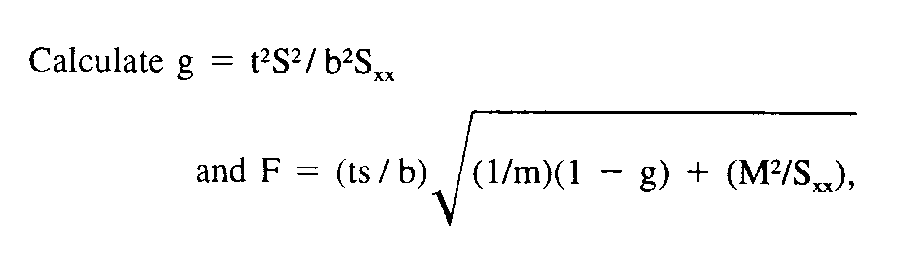
(7)Calculate the confidence limits (upper and lower)for the relative potency,R,using the value s2=MSRES3(see Table 1and Table 2)as follows.Obtain tfrom a table for a tdistribution having 4m-4degrees of freedom.For the 95%limits,the tvalues can be obtained from Table 9under Design and Analysis of Biological Assays á111ñ.
NOTE—For confidence limits having other probability levels (i.e.,100(1-a)%),the right tail tcritical value having a/2area to its right is used.
;)
and calculate
ML=(M-F)/(1-g),
and
MU=(M+F)/(1-g),
whereMis the log potency andMLandMUare the log potency lower and upper confidence limits.The lower and upper confidence limits for the relative potency,R,are given by
RL=antilog (ML)
RU=antilog (MU)
It meets the requirements if the potency is between 0.8and 1.25USP Glucagon Units per mg,and the confidence interval width at P=0.95does not exceed 45%of the computed potency.
Table 1.ANOVAfor the Rat Hepatocyte Assay for Glucagon
| Source | Degrees of Freedom | SS(Sum of Squares) | MS(Mean Square) |
| Preparations | 1 | SSPREP | MSPREP |
| Replicates | 1 | SSREP | MSREP |
| Linear Slope | 1 | SSLIN | MSLIN |
| Residual3 | 4m –4 | SSRES3 | MSRES3 |
| Nonparallelism | 1 | SSNP | MSNP |
| Residual2 | 4m –5 | SSRES2 | MSRES2 |
| Nonlinearity | m –2 | SSNL | MSNL |
| Residual1 | 3m –3 | SSRES1 | MSRES1 |
| TOTAL | 4m –1 | SST |
NOTES—This analysis pertains to one sample assayed against a standard,using two replicates each.
The number of dose levels for each preparation is denoted by m.
Table 2gives the equations for calculating the SSterms.
In each row of the ANOVAtable,the MSis obtained by dividing the SSterm by the degrees of freedom.
Table 2.Equations for Calculating the Sums of Squares in the Analysis of Variance*
;)
|
|
*
Refer to the Calculationsfor section on Relative Potencyfor the definitions of xjand yijk.
|
Auxiliary Information—
Staff Liaison:Larry N.Callahan,Ph.D.,Scientist
Expert Committee:(BNT)Biotechnology and Natural Therapeutics/Diagnostics
USP28–NF23Page 905
Pharmacopeial Forum:Volume No.30(5)Page 1625
Phone Number:1-301-816-8385